Posts

Showing posts with the label standards

Blogbook -- Language Engagements in Communities
Image
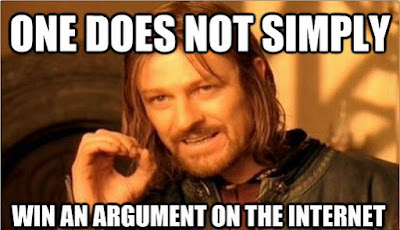
Entry 42 Too often in our lives, we don’t encounter arguments in the meaningful and ethical ways that schools, colleges, and academic disciplines often understand or assume them to be, nor do we encounter finding common ground, forming agreement, or making ethical decisions collaboratively. We don’t usually find people engaging in any of the habits I listed at the end of the last blogbook post 41 . What we get are unproductive shouting matches on CNN or Fox News, Twitter, Instagram, Youtube, or Facebook. People often just shout their claims at each other with little interest in engaging with anyone else’s evidence or reasoning, little interest in protecting those with whom they are engaging, and little interest in investigating their own biases or the ways their words do harm in the world.  Let me give you a simple example of what I mean. About 2 or 3 times a year, I get hate emails and tweets directed at me. Usually, they come after right-wing or conservative news media have poste...
Blogbook -- The Difficulty of Avoiding White Language Supremacy in Standards

Image
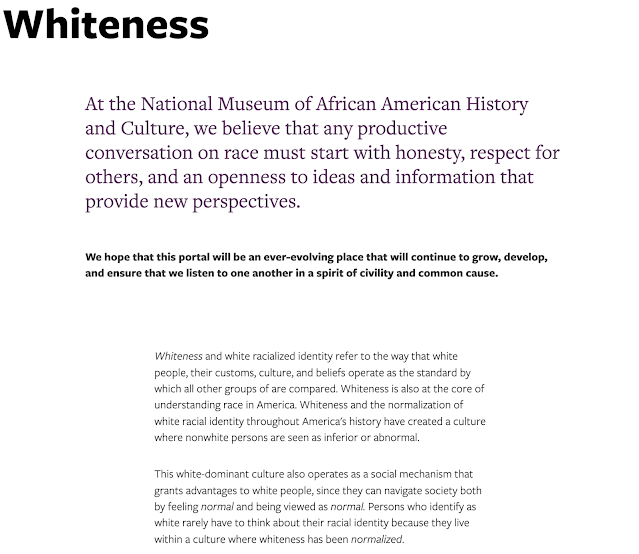
Entry 38 If what I’m saying about learning outcomes and standards for language seem counterintuitive or wrong, it’s because the systems we live in are built on whiteness (see post 28 on HOWL ), and that whiteness is hard to recognize as politicized or positional (that is, biased). Whiteness is a deep part of the structures that make us as teachers, our languaging, the CCSS, and the OS. The CCSS validation committee (listed in Reaching Higher: The Common Core State Standards Validation Committee ), is a collection of national experts and teachers, and they illustrate the problem I’m speaking of. The problem of white language supremacy is in part embodied in the whiteness of the people who created and validated the CCSS. The CCSS validation committee “was charged with providing independent, expert validation of the process of identifying the Common Core State Standards as part of the CCSSI” ( note 256 ). This committee essentially checked the work of the numerous other working groups and...

Blogbook -- Logocentric Languaging Next to Kisceral-centric Languaging

Image
Entry 37 From one angle, the focus on logocentric arguments in the CCSS for high school students and the OS for college students seems reasonable. Note the value-heavy adjective, “reasonable,” in my statement. Why is “reason” and “logical-ness” so highly valued in determining a standard for most writing in schools and colleges? We could say, as Davis does for the CCSS (see post 36 ), that this is what colleges and universities ask of students. And that wouldn’t be completely wrong. But that dodges the institutionally-created “need” for this kind of orientation in our students’ languaging. It also dodges where all disciplines and educational institutions get their ideas for what “logical” and “reason” mean. Colleges have wanted students to take SATs and ACTs, but those standardized tests have been shown to be culturally biased, white supremacist, and produce racial scoring gaps that help create racial inequity ( note 251 ). So what colleges want from students has often been fallible, ...

blogbook -- Assuming White Arguments and False Binaries

Image
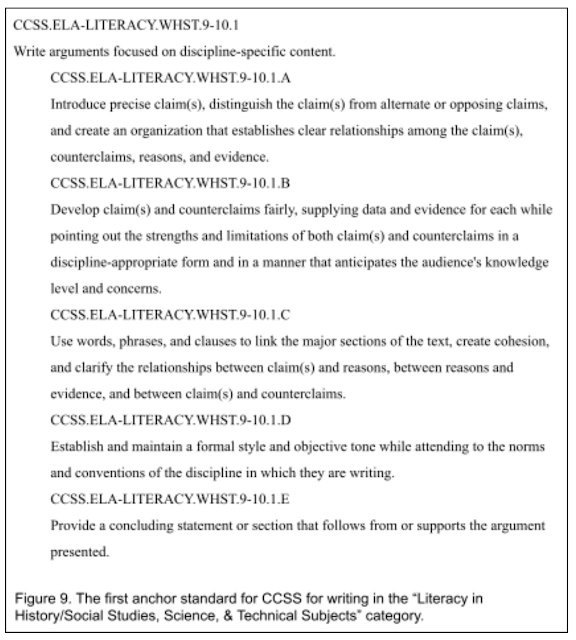
Entry 36 Over the last five posts, we’ve been looking at the CCSS language standards, but what about the CCSS’s writing standards? In the writing standard group ( CCSS.ELA-LITERACY.WHST.9-10.1 ), the first anchor standard is broken up into five standards for ninth and tenth graders (standards A-E). The first broad anchor standard states: “Write arguments focused on discipline-specific content.” It seems straightforward enough. The key element in this anchor standard is “argument” as opposed to persuasion. The key contexts that students are to orient themselves toward are “discipline-specific.” It is a decidedly textual standard, but then it is a “writing” standard. I’m gonna avoid a deep discussion of the obvious problem with this standard, that is the eurocentric and white supremacist assumptions of what counts as “arguments” and “discipline-specific.” This is similar to what  LuMing Mao has discussed as a problem with many comparative rhetorics, that of “euroamerican-centrism.” T...

Blogbook -- The Circular Logic of Standardized English

Image
Entry 35 In posts 30 , 32 , 33 , and 34 , I discussed the CCSS L.11-12.1 anchor standard and the first of the standards underneath it (L.11-12.1.A). Now, consider the second standard, L.11-12.1.B. It is equally problematic as the first. And it works to maintain the white language supremacy, or a single standard that is dominant in all schools and colleges. It also exemplifies a problem that such standards tend to have when used in classrooms. It’s a problem of circularity, of being one’s own judge.  L.11-12.1.B states, “Resolve issues of complex or contested usage, consulting references (e.g., Merriam-Webster's Dictionary of English Usage , Garner's Modern American Usage ) as needed.” This standard reinforces white habits of English language in classrooms by using as a yardstick the very standard being contested. So according to this standard, the way you resolve a contested usage is to consult references that point back to the standard. Do you see the problem? This is overdet...