Posts

Showing posts with the label CCSS

Blogbook -- The Politics of Whiteness in the Logics of Outcomes

Image
Entry 40 In my last post ( post 39 ), I discussed the ways white male authors and their historically cultivated habits of language deeply inform the CCSS and its appendix essay , which explains the focus on “argument” over “persuasion” when teaching language and writing to high school students in the U.S.  But I was just getting started in explaining the problems with the appendix essay and the focus on argument. There’s more. I’ll continue in this post. The reason I go into such detail about the appendix’s discussion is that it is indicative of most logics in all course or programmatic outcomes, in both secondary and postsecondary contexts, and it’s good to know what we must orient ourselves against and why if we wish to be antiracist.  The appendix’s discussion of “writing” explains three kinds of writing students should learn: “argument,” “informational/explanatory writing,” and “narrative.” However, half or more of this larger section in the appendix on writing focuses on ...

Blogbook -- Only White Men

Image
Entry 39 Let’s look deeper into the CCSS’ appendix to understand the fullness of the problem of whiteness, which is a bigger problem in the academy than just the CCSS. This problem comes from the historical and material conditions we live in. The anonymous authors of the appendix draw on only white male university professors and writing researchers to make their point about the outcomes of writing classrooms being mostly logocentric and “argument” based. They reference Gerald Graff, Neil Postman, Joseph M. Williams, and Lawrence McEnerney. They quote Williams and McEnerney of the University of Chicago Writing Program, and explain that the authors “define argument not as ‘wrangling’ but as ‘a serious and focused conversation among people who are intensely interested in getting to the bottom of things cooperatively’” ( note 264 ).  This ain’t a bad way to think about arguments, for sure. I like the focus on “getting to the bottom of things” through cooperation. But it isn’t the only ...

Blogbook -- The Difficulty of Avoiding White Language Supremacy in Standards

Image
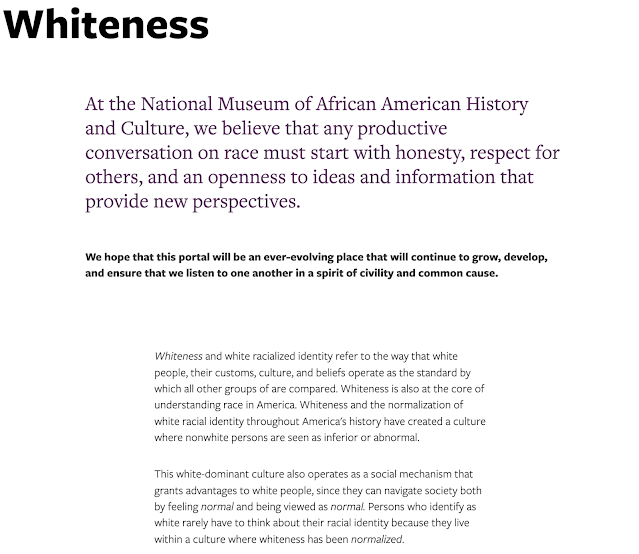
Entry 38 If what I’m saying about learning outcomes and standards for language seem counterintuitive or wrong, it’s because the systems we live in are built on whiteness (see post 28 on HOWL ), and that whiteness is hard to recognize as politicized or positional (that is, biased). Whiteness is a deep part of the structures that make us as teachers, our languaging, the CCSS, and the OS. The CCSS validation committee (listed in Reaching Higher: The Common Core State Standards Validation Committee ), is a collection of national experts and teachers, and they illustrate the problem I’m speaking of. The problem of white language supremacy is in part embodied in the whiteness of the people who created and validated the CCSS. The CCSS validation committee “was charged with providing independent, expert validation of the process of identifying the Common Core State Standards as part of the CCSSI” ( note 256 ). This committee essentially checked the work of the numerous other working groups and...

Blogbook -- Logocentric Languaging Next to Kisceral-centric Languaging

Image
Entry 37 From one angle, the focus on logocentric arguments in the CCSS for high school students and the OS for college students seems reasonable. Note the value-heavy adjective, “reasonable,” in my statement. Why is “reason” and “logical-ness” so highly valued in determining a standard for most writing in schools and colleges? We could say, as Davis does for the CCSS (see post 36 ), that this is what colleges and universities ask of students. And that wouldn’t be completely wrong. But that dodges the institutionally-created “need” for this kind of orientation in our students’ languaging. It also dodges where all disciplines and educational institutions get their ideas for what “logical” and “reason” mean. Colleges have wanted students to take SATs and ACTs, but those standardized tests have been shown to be culturally biased, white supremacist, and produce racial scoring gaps that help create racial inequity ( note 251 ). So what colleges want from students has often been fallible, ...

blogbook -- Assuming White Arguments and False Binaries

Image
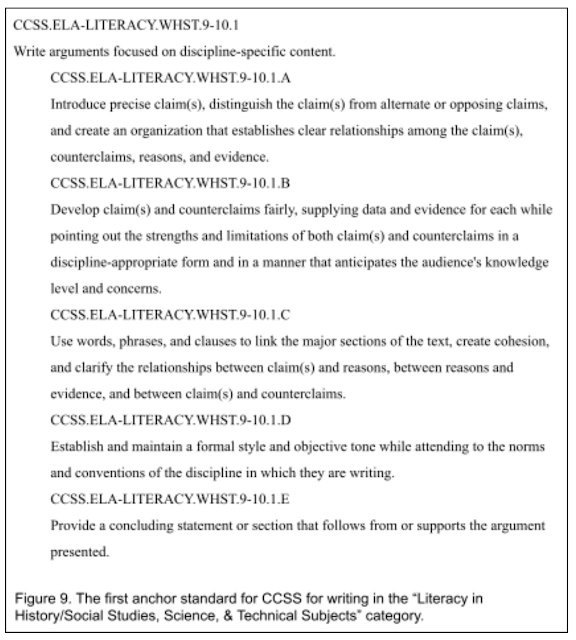
Entry 36 Over the last five posts, we’ve been looking at the CCSS language standards, but what about the CCSS’s writing standards? In the writing standard group ( CCSS.ELA-LITERACY.WHST.9-10.1 ), the first anchor standard is broken up into five standards for ninth and tenth graders (standards A-E). The first broad anchor standard states: “Write arguments focused on discipline-specific content.” It seems straightforward enough. The key element in this anchor standard is “argument” as opposed to persuasion. The key contexts that students are to orient themselves toward are “discipline-specific.” It is a decidedly textual standard, but then it is a “writing” standard. I’m gonna avoid a deep discussion of the obvious problem with this standard, that is the eurocentric and white supremacist assumptions of what counts as “arguments” and “discipline-specific.” This is similar to what  LuMing Mao has discussed as a problem with many comparative rhetorics, that of “euroamerican-centrism.” T...