Posts

Blogbook -- Confronting the Borderlands of the Language Race War

Image
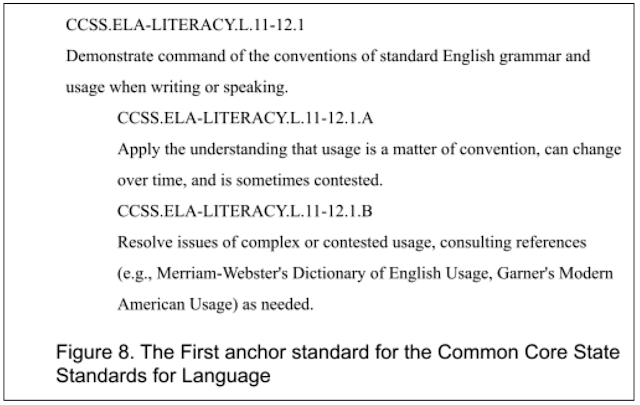
Entry 32 Let’s return to the CCSS, and drill down a level to the grade-specific standards that the anchor standard L.11-12.1 (from post 30 ) is translated into. Through the details, we might see ways to teach through such outcomes that may be demanded of literacy teachers at both the secondary and postsecondary levels. Many of us teachers are required to use such universal standards or outcomes. The grade-level standards L.11-12.1.A and L.11-12.1.B are articulated for only eleventh and twelfth grades. And they are the more specific outcomes for classrooms. According to these two standards, eleventh and twelfth grade students should be able to do the following: “Apply the understanding that usage is a matter of convention, can change over time, and is sometimes contested” (L.11-12.1.A); and “Resolve issues of complex or contested usage, consulting references (e.g., Merriam-Webster's Dictionary of English Usage , Garner's Modern American Usage ) as needed” (L.11-12.1.B).  Standa...
Blogbook -- A First Look at the WPA Outcomes

Image
Entry 31 A portion of this post was used in my Oct 1, 2021 keynote at the 2021 Conference for Antiracist Teaching, Language, and Assessment ( www.atlaconf.com ). To engage with the conference's materials and participants, see its ongoing forums: https://atlaconf.freeflarum.com/ .  Now, how might the WPA Outcomes Statement (OS) unintentionally participate in white language supremacy (WLS) in college writing classrooms? While surely most postsecondary teachers have more control over how they teach literacy and how they evaluate and grade student writing, the OS still exerts a powerful disciplinary pressure on college writing classrooms. It’s been an important artifact in the field of college writing studies and writing program administration for at least twenty years, starting with a listserv posting in 1996 by Ed White, a long-time grandfather of college writing assessment ( note 199 ). The OS has been through three formal revisions since it was first drafted, most recently in 2014....

Blogbook -- A First Look at the Common Core State Standards

Image
Entry 30  Let me turn to the first of my two central examples, the CCSS and OS . Consider the first anchor standard in the CCSS ( CCSS.ELA-LITERACY.L.11-12.1 ) in Figure 8. It is the first standard in the “Language” group for all grades. It states, “Demonstrate command of the conventions of standard English grammar and usage when writing or speaking” ( note 193 ). This anchor standard is the larger standard for language learning that all students are supposed to meet or demonstrate, so it is the same for all grade levels, but it means something progressively different as one moves up grade levels. This is why it is called an anchor standard, but it really acts as an outcome in the way I described it in the last post ( entry 29 ). The anchor is broad in scope and is meant to be defined more specifically for each grade level. But what is this anchor standard actually measuring in student performances in classrooms? The anchor standard 11-12.1 assumes English language as a unified an...